Assistant Professor, The University of Tokyo, [Our lab website: Weblab]
I work on reinforcement learning (RL), Monte Carlo gradient estimation, world models,
policy-gradient methods and their application to LLM and diffusion model post-training, and robotics.
My current research interests
are centered on two aspects: (1) efficient and reliable gradient estimators that leverage
differentiable simulators or dynamics models, (2) gradient estimators for set or retry-based
objectives.
Intro
I am originally from Estonia. In high school, I immensely
enjoyed mathematics and physics Olympiads, and these
experiences enabled me to study abroad in the UK and then in
Japan, where I now work. I really like the
field of machine learning and AI because it is highly useful
and impactful but also fun and involves a lot of neat mathematics.
My original education was in engineering, and in my work, I
strive to develop methods that are practical. But at the same time, I
want my results to last, so I put more focus on research topics
that I find fundamental. I hope my work will contribute to developing more
intelligent and safer AI systems. I believe the current bottleneck for this goal
is the algorithms, so that is where my attention is right now.
I received BA and MEng degrees from the University of Cambridge, where I was
advised by Carl Edward Rasmussen, and a PhD from the Okinawa Institute of Science
and Technology, advised by Kenji Doya. During my PhD, I was a visiting student in
Carl Edward Rasmussen’s lab at Cambridge, Jan Peters’ lab at TU Darmstadt, and Jun
Morimoto’s lab at ATR. I also completed research internships in Masashi Sugiyama’s
lab at RIKEN AIP and Rémi Munos’ lab at DeepMind Paris.
I am also actively looking for interns and collaborators;
please reach out to me via email if you are interested in
working on reinforcement learning, policy gradient methods,
LLM or diffusion model post-training.
Email: paavo dot parmas [at mark] weblab.t.u-tokyo.ac.jp
Recent news
Jul 2026ICML 2026 presentation— I will be co-presenting Emergence of Exploration via Retrying.
This page is a curated website rather than a complete bibliography. For the full publication list,
please check my Google Scholar profile.
OrderGrad: Optimizing Beyond the Mean with Order-Statistic Policy Gradient Estimation
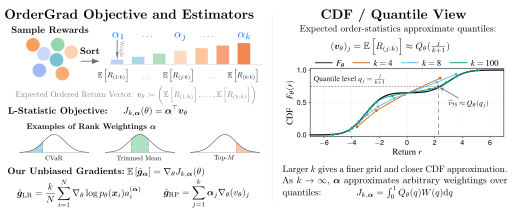
OrderGrad turns order statistics into rank-weighted policy-gradient objectives. The order statistics can be viewed as an
approximation to the CDF, so in essence, OrderGrad allows optimizing for arbitrary weightings of the reward distribution.
Paavo Parmas, Yongmin Kim, Kohsei Matsutani, Shota Takashiro, Soichiro Nishimori,
Takeshi Kojima, Yusuke Iwasawa, Yutaka Matsuo. OrderGrad: Optimizing Beyond the Mean
with Order-Statistic Policy Gradient Estimation. arXiv:2606.06096, 2026.
Description & My contribution
Description: Introduces OrderGrad, a family of policy gradient (RL) and reparameterization gradient estimators for
order-statistic objectives. While standard RL targets the mean reward, OrderGrad targets objectives such as CVaR, medians,
trimmed means, top-m, and best-of-K by changing rank weights rather than rewriting the
whole training algorithm. Using our code, the implementation is simple and requires only one line
of code for a reward transformation. Everything else about your code, whether you use GRPO, PPO, etc., can
remain the same. The approach is also orthogonal to these algorithms and can be combined with whichever one you want.
From a technical perspective, the method is a generalization of existing max@K optimization methods—max@K is
the special case of the top rank, while OrderGrad generalizes to arbitrary weightings of different ranks.
My contribution: Conceptualized the method, did the theoretical derivations, created the OrderGrad
code and did the toy experiments, proposed the TopM-BottomM joint experiment, led the project,
and led the writing. See the paper for the other contributions.
Shota Takashiro*, Soichiro Nishimori*, Paavo Parmas*, Yongmin Kim, Kohsei Matsutani,
Gouki Minegishi, Yusuke Iwasawa, Takeshi Kojima, Yutaka Matsuo.
On Advantage Estimates for Max@K Policy Gradients. arXiv:2606.06080, 2026.
Description & My contribution
Description: Studies advantage estimation for pass@K and max@K policy gradients, especially the role
of baselines and advantage centering. The paper introduces a Leave-Two-Out baseline and
MaxPO for group-based reinforcement learning in LLM post-training. A key finding is that the
L2O baseline can cancel out any comparator-based baseline that depends on the other K-1
samples in the set. In essence, this means that our method may be the most natural baseline
for set objectives, such as max@K. An earlier version of this preprint was submitted to
ICML2026 but not accepted (OpenReview).
My contribution: Equal contribution; conceptualization, all key theoretical derivations, project oversight,
example code, and significant comments and editing of the paper. Other key contributors did the experiments and writing (see
the author contributions section in the paper for details).
Retry Policy Gradients in Continuous Action Spaces
Soichiro Nishimori, Paavo Parmas. Retry Policy Gradients in Continuous Action Spaces.
arXiv:2606.05888, 2026.
Description & My contribution
Description: Extends retry-based objectives such as max@K/ReMax to continuous action spaces using
pathwise derivative estimators, and introduces ReMAC, an actor-critic implementation.
My contribution: Mentored Soichiro Nishimori, advised on the theoretical analysis, algorithm design, and
experimental design, co-conceptualized the idea, and revised the manuscript.
Finite-Time Regret Analysis of Retry-Aware Bandits
Bingkui Tong, Junpei Komiyama, Soichiro Nishimori, Paavo Parmas.
Finite-Time Regret Analysis of Retry-Aware Bandits. arXiv:2605.20854, 2026.
Description & My contribution
Description: Studies a stochastic bandit algorithm motivated by retry-aware objectives such as pass@K
and max@K, and proves a sublinear regret bound for a Gaussian two-retry setting. This work is
interesting because it provides a theoretical backing for using these popular objectives for
exploration.
My contribution: Proposed the algorithm, created the initial implementation and preliminary Gaussian bandit
experiments, derived the initial expected-improvement balance condition, initiated the
theoretical collaboration, and oversaw the project. Most of the hard theoretical derivations were
done by Bingkui and Junpei, and the final experiments were done by Soichiro.
This is a selected list of highlighted papers, not an exhaustive publication list.
For the full list, please check my
Google Scholar profile.
Emergence of Exploration in Policy Gradient Reinforcement Learning via Retrying
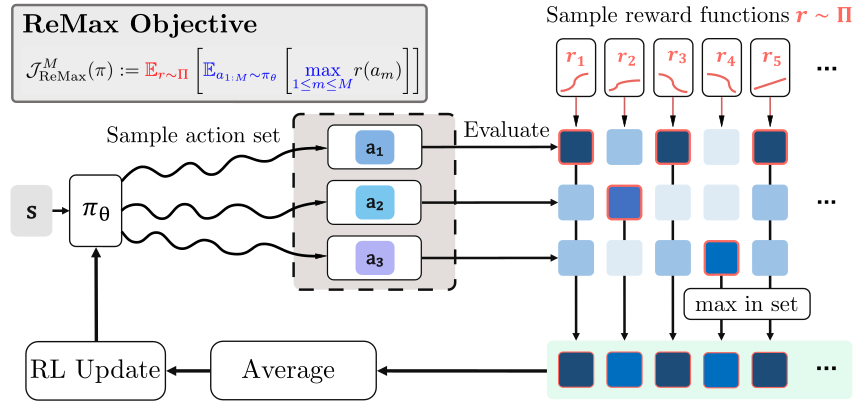
The ReMax objective is the expectation of the maximum over a set of sampled actions.
Figure inspired by the Vector Policy Optimization Figure 2.
Soichiro Nishimori, Paavo Parmas, Sotetsu Koyamada, Tadashi Kozuno, Toshinori Kitamura,
Shin Ishii, Yutaka Matsuo. Emergence of Exploration in Policy Gradient Reinforcement
Learning via Retrying. Proceedings of the 43rd International Conference on Machine
Learning (ICML), 2026.
Description & My contribution
Description: Introduces ReMax, a retry-based reinforcement learning objective that evaluates a policy by the
expected maximum return over multiple action samples, and promotes exploration.
The motivation for the approach is that agents only benefit from exploration if they
encounter the same or similar situation multiple times—if each state is unique, then
the greedy (maximum expectation) action would be optimal each time. But due to uncertainty about
the rewards, and the ability to retry at later encounters, it becomes beneficial to explore to
increase future rewards. This motivation naturally led to the ReMax objective.
This objective leads to the emergence of a stochastic exploratory policy
despite the objective being greedy maximization of the reward. The policy becomes exploratory
without explicit exploration bonuses, such as entropy bonuses.
The paper derives an unbiased policy-gradient
estimator for optimizing objectives defined over sets of sampled actions (now also called
SetRL) through our expected-improvement
formulation. An earlier version of this idea appeared in our
2022 preprint, where resetting leads to objectives over
trajectory-trees
(OpenReview),
which also considered uncertain reward functions and showed
that, under the ReMax objective, the optimal policy
generally becomes stochastic. This contrasts with
standard reinforcement learning, where the optimal policy is
deterministic. The 2026 paper extends these ideas into a
practical policy-gradient algorithm (RePPO). I believe the linked 2022 preprint was the first
work to derive the basic set policy gradient, and later works such
as Vector Policy Optimization and other SetRL variants optimize objectives that are
mathematically special cases (often with some specific
focus and impressive scaled up experiments, or with improved gradient estimation
techniques).
My contribution: The project
started in 2021 when I proposed the idea to Sotetsu Koyamada
who initially worked on it based on my guidance. I moved to
UTokyo and the project restarted in August 2024 when
Soichiro Nishimori started working on it as his internship
project under my guidance. My contributions in the final
manuscript are as follows: I conceptualized the idea; did all
of the key mathematical derivations (derivation of the
gradient estimator, the expected improvement formulation,
proposal of the final version of continuous m, came up with
the bandit algorithm, proposed RePPO, hypothesized the
adaptive properties of ReMax, e.g., the ones in Figure 1);
example implementations (first REINFORCE implementation for
ReMax, first ReMax bandit implementations, some
debugging); significant comments and editing on the paper.
The first author Soichiro, who I mentored, did most of the final implementations,
experimentation and was the lead writer (see author contributions in the paper
for full details).
Does “Do Differentiable Simulators Give Better Policy Gradients?” Give Better Policy Gradients?
Ku Onoda, Paavo Parmas, Manato Yaguchi, Yutaka Matsuo.
Does “Do Differentiable Simulators Give Better Policy Gradients?” Give Better Policy
Gradients? International Conference on Learning Representations (ICLR), 2026.
Description & My contribution
Description: Re-examines policy-gradient learning with differentiable simulators under discontinuities,
introducing DDCG for estimator switching in nonsmooth regions and IVW-H for variance
control in differentiable robotics control tasks. One of the key findings is that
variance, not bias, may be the major culprit in gradient-based learning with differentiable
simulators—at least on the standard continuous control robot benchmarks considered in this paper.
The IVW-H method is similar to my previous
total propagation in the sense that it also has separate time-step-wise weights for combining
estimators, but the implementation is simpler on differentiable simulators. I expect that
total propagation would perform better though. This work showed that composite gradient estimators can yield
large improvements in performance on standard benchmark tasks.
My contribution: Conceptualized the idea; derived most equations including the DDCG method; made the first
IVW implementation for the DFlex simulator tasks; proposed IVW-H implementation details;
oversaw the project; and contributed interpretation, comments, and edits.
Akihiro Kubo, Paavo Parmas, Shin Ishii.
Double Horizon Model-Based Policy Optimization. Transactions on Machine Learning
Research, 2025.
Description & My contribution
Description: Separates the horizon used to generate model-based rollout distributions from the horizon used
for policy-gradient training, balancing distribution shift, model bias, and gradient instability.
The main strength of this paper is the empirical performance. Both the computational and data efficiency
are several times better than the standard MBPO algorithm. Moreover, the hyperparameters are fixed and shared
across all of the tasks, unlike the standard MBPO. Please use this as a baseline instead of MBPO or more generally,
as a simple ensemble model-based RL baseline.
My contribution: Advised Akihiro Kubo through the project, making many suggestions about technical points, experiments and about the
writing. Helped debug the code.
Model-based Reinforcement Learning with Scalable Composite Policy Gradient Estimators
Total Propagation X extends composite policy-gradient estimators to model-based reinforcement learning with world models and shows that they scale.
Paavo Parmas, Takuma Seno, Yuma Aoki.
Model-based Reinforcement Learning with Scalable Composite Policy Gradient Estimators.
Proceedings of the 40th International Conference on Machine Learning (ICML), 2023.
Description & My contribution
Description: Scales composite policy-gradient estimators into modern model-based reinforcement learning,
combining likelihood ratio and reparameterization-style gradients in a practical algorithm.
The new TotalPropagation X algorithm is considerably simpler to use and implement compared to the
original TotalPropagation.
My contribution: Invented TPX, wrote and debugged most of the code, ran the experiments, performed the
analysis, and wrote the paper.
Proppo: a Message Passing Framework for Customizable and Composable Learning Algorithms
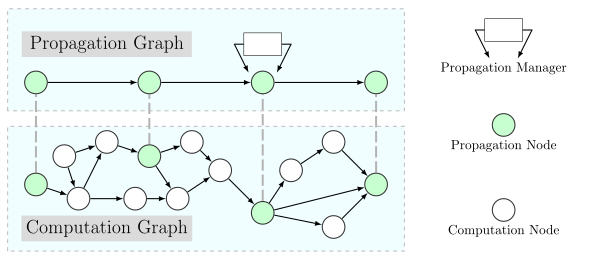
Proppo represents learning algorithms as message passing on propagation graphs.
Paavo Parmas, Takuma Seno.
Proppo: a Message Passing Framework for Customizable and Composable Learning Algorithms.
Advances in Neural Information Processing Systems (NeurIPS), 2022.
Description & My contribution
Description: Introduces automatic propagation, a message-passing framework that generalizes automatic
differentiation and allows custom learning algorithms to be packaged as reusable propagators.
The main motivation for this work was to create a framework that allows automatically using the
total propagation algorithm and other methods that I had created. These algorithms are not
easily implemented using standard automatic differentiation software, and Proppo is a wrapper
on top of AD that alters and automates specialized computations. Additionally, the chaotic recurrent
neural network toy experiments in the paper showed that total propagation can improve the gradient
estimation accuracy by ~100 times compared to naïve gradient combination schemes with no
time-step-wise weighting.
My contribution: I invented automatic propagation software, designed and implemented most of the code
including the key parts, ran the experiments, and wrote the paper.
Takuma worked part-time to help write the code and give advice on the software engineering
aspects in the early stages of the project. He also gave comments on the paper.
A Unified View of Likelihood Ratio and Reparameterization Gradients
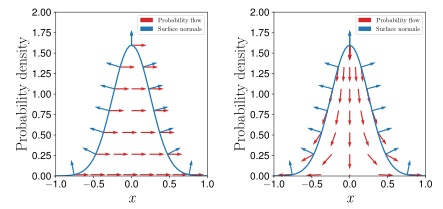
The paper explains likelihood ratio and reparameterization gradients as two ways of tracking probability mass.
Paavo Parmas, Masashi Sugiyama.
A Unified View of Likelihood Ratio and Reparameterization Gradients.
Proceedings of the 24th International Conference on Artificial Intelligence and Statistics
(AISTATS), 2021.
Description & My contribution
Description: Gives a first-principles view of likelihood ratio (LR) and reparameterization (RP) gradients as two ways
of tracking the movement of probability mass, connecting the estimators via the divergence theorem.
In particular, the LR estimator becomes an integral over the surface, while the RP estimator becomes
an integral over the volume.
Additionally, it characterizes the space of all gradient estimators that are constructed as linear
combinations of the function value and its derivative. This includes LR and RP as special cases.
My contribution: I conceputalized the idea, did all of the mathematical analysis, the discussion, the experiments, and wrote the paper.
Neural Replicator Dynamics: Multiagent Learning via Hedging Policy Gradients
Daniel Hennes, Dustin Morrill, Shayegan Omidshafiei, Rémi Munos, Julien Pérolat,
Marc Lanctot, Audrunas Gruslys, Jean-Baptiste Lespiau, Paavo Parmas,
Edgar A. Duéñez-Guzmán, Karl Tuyls.
Neural Replicator Dynamics: Multiagent Learning via Hedging Policy Gradients.
International Conference on Autonomous Agents and Multiagent Systems (AAMAS), 2020.
Description & My contribution
Description: I worked on this project as an intern at DeepMind.
The work studies multiagent learning using policy-gradient dynamics inspired by hedging and replicator dynamics. Proposes
the Neural Replicator Dynamics method for multiagent learning.
My contribution: My
contributions were mostly in mathematically and
computationally analyzing the algorithm. This led to a
better understanding and influenced the writing of some
sections, as well as influenced which experimental results
were included.
PhD Thesis: Total Stochastic Gradient Algorithms and Applications to Model-Based Reinforcement Learning
Paavo Parmas. Total Stochastic Gradient Algorithms and Applications to Model-Based
Reinforcement Learning. PhD thesis, Okinawa Institute of Science and Technology
Graduate University, 2020.
Description & My contribution
Description: Develops a collection of stochastic-gradient algorithms for improved Monte Carlo gradient
estimation, motivated by chaos-like gradient variance in model-based reinforcement learning.
The thesis includes PIPPS, total propagation, probabilistic computation graphs, policy-gradient
estimators, and a unified view of likelihood ratio and reparameterization gradients.
PIPPS: Flexible Model-Based Policy Search Robust to the Curse of Chaos
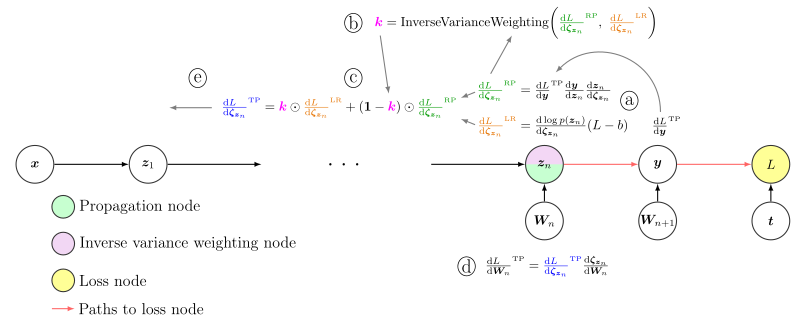
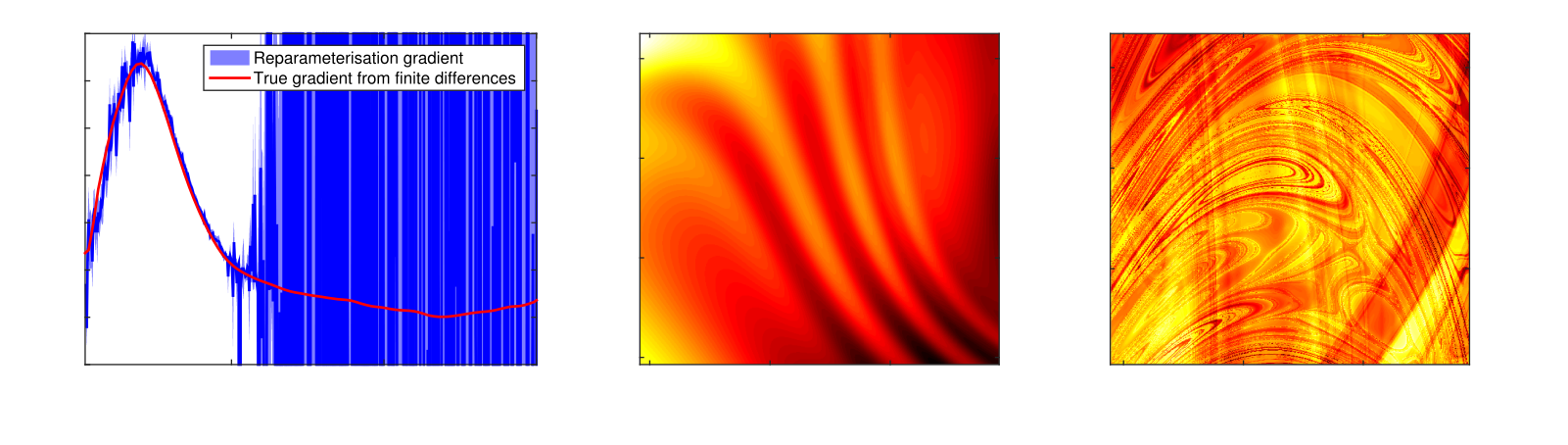
PIPPS studies chaos-like instability in long-horizon model-based policy gradients and introduces total propagation.
Paavo Parmas, Carl Edward Rasmussen, Jan Peters, Kenji Doya.
PIPPS: Flexible Model-Based Policy Search Robust to the Curse of Chaos.
Proceedings of the 35th International Conference on Machine Learning (ICML), 2018.
Description & My contribution
Description: This is my most impactful work to date but I feel it could have been even more impactful.
The starting point of the research was to develop a trajectory-sampling-based method for policy
optimization in model-based RL; however, the key findings are more general. The core contributions
are: (1) demonstrated that chaos causes
gradient variance explosion in long chains of non-linear computations (e.g., model-based RL, deep learning,
time-series models, etc., while the focus was on MBRL); (2) showed that 0th-order likelihood ratio gradients can be drastically better than 1st-order
backpropagation/reparameterization gradients in practical problems (at the time, it was widely believed
that you should always use 1st-order gradients when available); (3) developed a mixed gradient estimator that
takes the average of 0th-order and 1st-order gradient estimators kg0 + (1 − k) g1, and created a
step-wise combination scheme total propagation as a replacement for backpropagation.
My contribution: This work grew
out of my lab visits to Carl Edward Rasmussen's lab at the
University of Cambridge, and Jan Peters' lab at TU Darmstadt
for ~3 months each. The original particle sampling idea was
also tried in Andrew McHutchon's PhD thesis, but they
couldn't get it to work. My initial idea was to use
probabilistic line searches to try to obtain good
performance with this method. However, while running the
experiments, I ran into problems with unstable learning and
tried to figure out what the issue was. At the time, I was
at Carl's lab, and he contributed to figuring out the
issues, e.g., by suggesting plotting the landscapes and the
gradients, and frequently discussing the issue with
me. After leaving his lab, I continued analyzing the
problem, and figured it out. To try to obtain better
gradient estimates, I figured that likelihood ratio
gradients may be better. My initial performance with these
methods was not great, and I thought that baseline
techniques may be necessary to improve the performance. I
showed the results to Jan Peters and discussed baseline
techniques, and he urged me to add a variance reduction
baseline. Finally, after returning to my home institute, I
combined both likelihood ratio and reparameterization
gradients with a new total propagation algorithm and
achieved good performance. Kenji Doya was my PhD advisor
and helped improve the clarity of the paper. In summary, I
completed the experimental analysis, decided on the
experimental details (such as using fixed seeds, errorbars,
etc.), ran the experiments, created the particle-sampling-based
implementation, proposed and implemented the idea of
using inverse-variance weighting for combining gradients as
well as the total propagation algorithm, did the mathematical
derivations and wrote the
paper.
Total Stochastic Gradient Algorithms and Applications in Reinforcement Learning
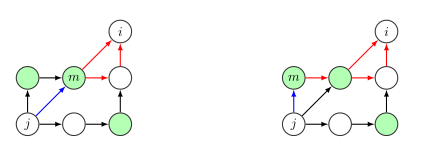
Total stochastic gradient algorithms use graph structure and the total derivative rule to organize gradient estimators.
Paavo Parmas. Total Stochastic Gradient Algorithms and Applications in Reinforcement
Learning. Advances in Neural Information Processing Systems (NeurIPS), 2018.
Description & My contribution
Description: Uses the total derivative rule as a visual and algorithmic framework for constructing gradient
estimators on stochastic computation graphs, including reinforcement-learning applications. For example,
it gives a unified derivation for the stochastic and deterministic policy gradient theorems, and allows
deriving them by inspection visually from the graph.